


Hospital sterilizer tender specifications should define the intended application, usable chamber capacity, cycle performance, safety interlocks, data records, site and installation requirements, qualification evidence, training, and commercial support before any supplier is invited to quote. A well prepared specification gives suppliers a common, measurable brief. It also gives the evaluation committee a consistent basis for comparing bids and the equipment eventually delivered, reducing the ambiguity that otherwise surfaces once installation and acceptance testing begin.
Hospital Sterilizer Application and Sterilization Technology
A tender for a hospital sterilizer should start by defining what the equipment needs to process, not by naming a product category. Clinical, biomedical engineering and procurement teams should jointly agree on:
- The instruments and devices to be processed
- Packaging and material compatibility
- The department’s expected workflow
- Heat or moisture sensitive items that rule out certain methods
- The relevant manufacturer instructions for processing each device type
A generic request for a hospital sterilizer invites bids across different technologies and produces responses that cannot be compared on equal terms. Hospital sterilizer procurement works best when the sterilization method is identified first, since chamber size, cycle controls and site requirements all follow from that decision.
For an ETO sterilizer tender, the specification should treat conditioning, gas exposure and aeration as separate processing stages. Ethylene oxide residue limits apply as an acceptance criterion once aeration is complete, not as a processing stage in themselves; completing gas exposure alone does not make a load ready for clinical use.
 Email Us Today!
Hospital Sterilizer Chamber Capacity and Loading Volume
Chamber capacity should be defined in terms of usable loading space, not nominal litres alone. The specification should distinguish internal dimensions from the clearance needed for trays, baskets or trolleys, since loading accessories reduce the space actually available for a load. These hospital sterilizer technical specifications should also record:
- Expected load types and packaging
- Batch frequency and current demand
- A reasonable allowance for future growth
- Throughput assumptions for the full workflow, not just the cycle itself
Chamber sizes vary considerably across suppliers and product ranges. The tender should ask a hospital sterilization equipment supplier to confirm usable capacity, door configuration and accessory compatibility against the hospital’s own stated load, rather than relying on published litre or cubic foot figures in isolation.
Complete EO throughput includes conditioning, exposure, aeration and unloading time, not loading and cycle time alone. Hospital equipment procurement teams should ask suppliers to substantiate throughput claims against the full processing workflow rather than chamber volume on its own. The tender should avoid prescribing a universal capacity or cycle duration; these depend on the hospital’s own case mix and should be confirmed through the supplier’s proposal.
Hospital Sterilizer Cycle Controls and Performance Criteria
Rather than relying on vague terms such as fully automatic, the tender should specify the outcomes the equipment must achieve and the operating ranges considered acceptable. Where relevant to the chosen technology, this covers:
- Cycle stages and recipe management
- Temperature, humidity, pressure and vacuum monitoring
- EO admission and exposure control
- Gas removal and aeration arrangements
- Sensor accuracy and calibration expectations
- Response to a cycle interruption
- Parameter tolerances and acceptance criteria for each stage
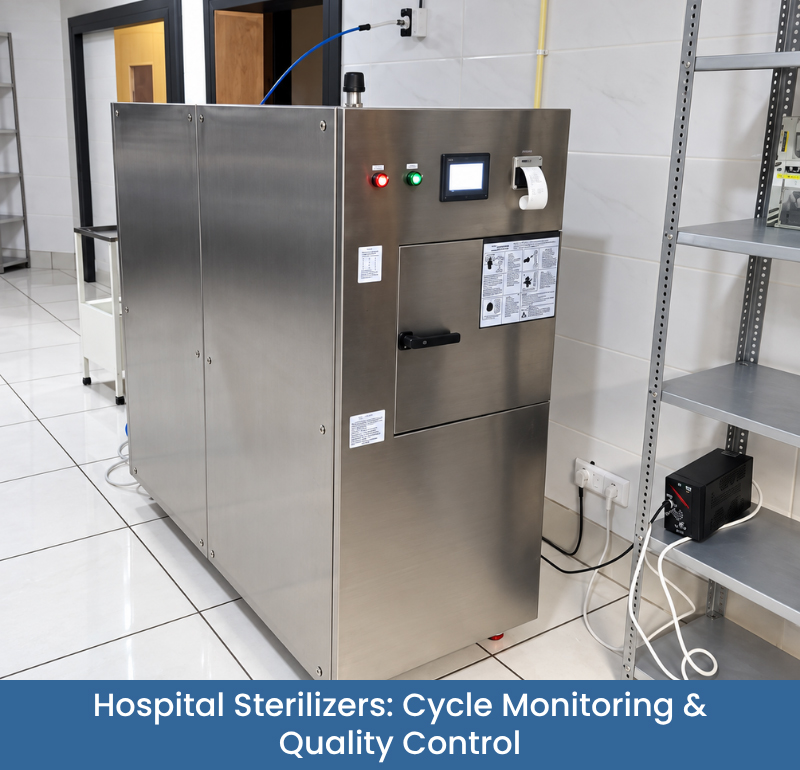
These tolerances describe what the equipment is capable of delivering under defined operating conditions. The tender should require suppliers to demonstrate, through documented testing such as Factory Acceptance Testing, that the delivered equipment actually meets these tolerances, rather than accepting a general assurance of performance.
Hospital Sterilizer Door Configuration and Chamber Construction
Door configuration affects both workflow and infection control layout. The tender should state:
- Whether a single door or double door arrangement is required
- How this fits the intended loading and unloading sequence
- How the equipment will sit relative to clean and used item routes
- Chamber material and finish requirements
- Seals, racks and other loading accessories needed
- Cleaning and maintenance accessibility
Construction requirements should be justified by the application and applicable standards, rather than by unsupported claims about material grade or wall thickness.
Hospital Sterilizer Safety Alarms and Interlocks
The tender should identify the protective functions required and the evidence a supplier must provide to demonstrate them, rather than listing safety as a general assurance. Depending on the technology selected, relevant considerations may include:
- Safe door release conditions
- Pressure and vacuum safeguards
- Chamber integrity or leak checks
- Emergency stop functions
- EO detection and gas isolation arrangements
- Ventilation interlock interfaces
- Audible and visual alarms
- Access restrictions
- Power failure responses
Suppliers should explain the specific alarm conditions built into the equipment, the automatic responses triggered, and what is required to reset the system after each alarm type.
Room ventilation, evacuation procedures and other exposure controls that the hospital itself must provide should be defined as installation and site requirements, since they sit outside the equipment’s own safety systems. The tender should not assume one safety configuration suits every site, or specify detector thresholds without confirming them against the standard applicable to the chosen technology.
Hospital Sterilizer Data Recording and Reporting Requirements
Buyers should specify what the equipment must record and how that information will be accessed:
- Batch and cycle identification
- Critical process parameter records
- Operator identification and timestamps
- Alarm and event history
- Available report formats and export options
- Access permissions
- Record retention and backup arrangements
- Audit trails where applicable
The tender should ask the supplier to demonstrate, through a sample report, that the required fields are actually captured and retrievable.
A printed cycle report confirms that the parameters were recorded, not that the cycle met its acceptance criteria. The recorded values still need to be reviewed against the agreed operating tolerances before a load can be considered successfully processed. The report does not, by itself, establish complete regulatory compliance or authorise automatic release of a load, which remains a separate clinical and quality decision.
Hospital Sterilizer Installation and Utility Requirements
Installation requirements are easier to compare when the tender separates what the hospital can already provide from what the proposed equipment needs:
- Utilities available at the site
- Utilities required by the equipment
- The supplier’s declared consumption and peak demand
- The exact connection points at which responsibility passes from one party to the other
- Access routes, floor loading, service clearances and site readiness checks
Relevant utilities may include power, water, steam, compressed air, ventilation, exhaust, gas supply, drainage and any other supporting systems the technology requires.
For EO installations, aeration and emission treatment interfaces are worth addressing explicitly, alongside room ventilation, evacuation procedures and other exposure controls that the hospital itself must provide around the equipment. Buyers should state clearly who provides, installs, connects and commissions each item, since supporting infrastructure is not always included within the quoted equipment price.
Hospital Sterilizer Qualification and Acceptance Documents
The tender should list the documents and evidence a supplier is expected to provide:
- Approved drawings and technical schedules
- Operating and maintenance manuals
- Instrument lists with calibration certificates
- Applicable conformity evidence
- Factory Acceptance Test and Site Acceptance Test protocols and reports
- Installation and Operational Qualification documents or support
- Defined acceptance criteria with a process for recording deviations
This is where a supplier demonstrates, through documented testing and records, that cycle performance meets the agreed operating tolerances. Equipment qualification and product or load specific process validation serve different purposes and should not be treated as interchangeable: qualification confirms the equipment performs to its specification, while process validation confirms the equipment achieves sterility for the hospital’s specific load.
For ethylene oxide equipment, ISO 11135 addresses process development, validation and routine control. It applies to EO sterilization specifically, and a tender for a different technology should reference the standard applicable to that method rather than treating any one standard as universal. For each deliverable, the tender should state who prepares, executes, reviews and approves the work, and whether it is included within the quoted price or offered separately; equipment purchase does not automatically include complete process validation.
Hospital Sterilizer Operator Training and Handover
Training requirements should identify the intended trainee groups, where and when training will take place, and the content to be covered:
- Normal operation and load preparation
- Alarm handling and emergency actions
- Record review and routine checks
- The boundary of maintenance tasks operators are expected to perform themselves
The tender should also define how competence will be assessed and recorded, since attendance at a training session is not the same as demonstrated ability to operate the equipment safely. Handover completion criteria, the point at which the hospital formally accepts responsibility for day to day operation, should be stated explicitly rather than left to informal agreement.
Hospital Sterilizer Warranty and Service Support
Commercial terms are easier to compare when stated explicitly rather than left as general assurances. The tender should ask suppliers to confirm:
- Warranty commencement and any exclusions
- The scope of installation and commissioning included
- Service contact and escalation arrangements
- Response and restoration commitments
- Preventive maintenance scope
- Critical spare parts and their expected availability
- Consumables and other recurring costs
- Software updates and backup arrangements where relevant
- Any charges excluded from the quoted price
Durations and service levels should remain buyer defined or supplier confirmed rather than assumed. Comparing bids on equivalent supply and support scope, not only on headline price, helps the evaluation committee identify offers that look similar on paper but carry different long term obligations.
Hospital Sterilizer Tender Checklist for Bid Evaluation
A sterilizer tender checklist gives the evaluation committee a consistent way to record how each bid responds to the tender’s requirements, using measurable wording rather than general impressions.
Many requirements can only be confirmed once equipment is delivered. The checklist should separate what a bid should demonstrate at the time of quotation from what the supplier must still confirm at installation and acceptance.
| Requirement Category | Buyer Requirement | Evidence Expected at Bid Stage | Evidence Required at Acceptance |
| Application | Defined instrument and material list with sterilization method | Written confirmation of compatibility | Delivered equipment confirmed against the specified instruments and materials |
| Usable capacity | Defined loading arrangement and dimensions | Proposed usable dimensions against the stated arrangement | Usable dimensions verified at FAT or SAT |
| Cycle controls | Stated parameter tolerances and monitoring | Proposed cycle parameters and tolerances | Sample cycle data confirmed at FAT |
| Safety | Listed interlocks and alarm conditions | Proposed interlock and alarm design | Approved testing verifying the specified interlock functions at SAT and commissioning |
| Data and records | Required record fields | Proposed report format and fields | Sample report demonstrating the required cycle record fields, captured live |
| Site interfaces | Defined utility and connection responsibilities | Declared consumption and proposed connection points | Connections confirmed and verified during installation |
| Qualification | Listed IQ, OQ and calibration documents | Proposed IQ and OQ protocols | Completed IQ and OQ reports with calibration records identifying instruments and traceability |
| Training | Defined trainee groups and competency criteria | Proposed training plan | Training records and competency assessment results |
| Delivery and commissioning | Agreed delivery, installation and commissioning schedule | Proposed schedule with named responsibilities | Completion confirmed against the agreed schedule |
| Commercial support | Warranty and service terms | Quoted warranty and service commitments | Signed warranty and service agreement |
| Accessories and costs | Included accessories, exclusions and recurring costs | Itemised quotation listing inclusions, exclusions and consumables | Delivered accessories matched against the quotation |
Each row can be marked Complies, Partially complies, Does not comply, Clarification required, or Alternative proposed. Separating mandatory requirements from optional preferences, and defining evaluation criteria before bids are invited, keeps the comparison aligned with applicable procurement rules and avoids unjustified brand specific conditions or decisions based only on price and headline capacity.
 WhatsApp Us
About Sterility Equipment India Private Limited
Sterility Equipment India Private Limited was founded in 2014 and is based in Ahmedabad, Gujarat. The company manufactures and exports ethylene oxide gas sterilizers, serving hospitals and medical colleges. Table Top ETO Sterilizers are available in 50, 60 and 85 litre chamber capacities, Fully Automatic ETO Sterilizers in 100, 120, 135, 150, 245 and 450 litre chamber capacities, and Industrial ETO Sterilizer Machines are sized in cubic feet with single door or double door chamber configurations.
Conclusion
A clear tender gives every supplier the same brief and gives the evaluation committee a consistent basis for comparison. Confirming the application and sterilization technology, approving measurable requirements for capacity, cycle controls and safety, assigning clear scope boundaries for installation, and agreeing the acceptance evidence expected at each stage before quotations are invited is what keeps bids genuinely comparable once they arrive.
Hospitals and procurement teams planning a new sterilizer procurement can discuss their application and equipment requirements directly with Sterility Equipment India Private Limited.