

Introduction to ETO Sterilizer URS Planning
Purchasing an ETO sterilizer involves more than selecting a chamber capacity and comparing prices. The proposed equipment must suit the products, packaging, load pattern, production target, available utilities, facility layout, operating workflow and quality requirements of the user. A carefully prepared User Requirement Specification converts these needs into clear and measurable criteria before quotations are requested. It gives engineering, quality, production and procurement teams a common basis for reviewing technical proposals while reducing the risk of overlooked requirements during installation, commissioning and qualification.
What Is an ETO Sterilizer User Requirement Specification?
An ETO sterilizer user requirement specification records what the proposed sterilizer must accomplish from operational, technical, safety, quality and documentation perspectives. Preparing it before sending an enquiry prevents selection based only on chamber volume, price or a standard feature list.
The ETO sterilizer URS should describe required outcomes, such as controlled cycle stages, traceable batch reports and restricted access for recipe changes. The supplier then proposes the technical solution, which forms part of the EO sterilizer specification and later engineering documents. Unless genuinely mandatory, the URS should not dictate every design detail.
This distinction matters during ETO sterilizer procurement. A hospital may prioritise workflow and operator access, while medical-device production may need higher throughput and formal project documentation. Industrial ETO sterilizer requirements must originate from actual loads and facility constraints. Buyers comparing ETO sterilizer manufacturers should issue the same approved URS to every bidder.
Product and Load Requirements for an ETO Sterilizer
Identify every product family, its materials, packaging and the dimensions of cartons, pallets, trays or baskets. Describe minimum, maximum and mixed-load patterns. Include load density and products with lumens, porous sections, electronics, or heat- or moisture-sensitive components.
Include expected product or packaging changes. This supports compatibility assessment, loading design and later process development, but does not replace product-specific validation.
ETO Chamber Specifications for Capacity and Throughput
State batches per day or week, operating shifts, expected growth and maximum load dimensions. Ask suppliers to identify usable chamber volume, allowing for loading accessories and clearance, rather than nominal capacity alone.
The ETO chamber specifications should define whether a single-door or double-door arrangement is required. This choice should follow material flow, segregation and room layout. Sterility Equipment India Private Limited offers industrial chambers with single- or double-door designs based on customer requirements; the URS should still state which workflow the site needs.
Document the installation envelope, access route, loading areas and service clearance. Both insufficient and unnecessary capacity can create operational problems.
ETO Sterilization Cycle Control and Process Monitoring Requirements
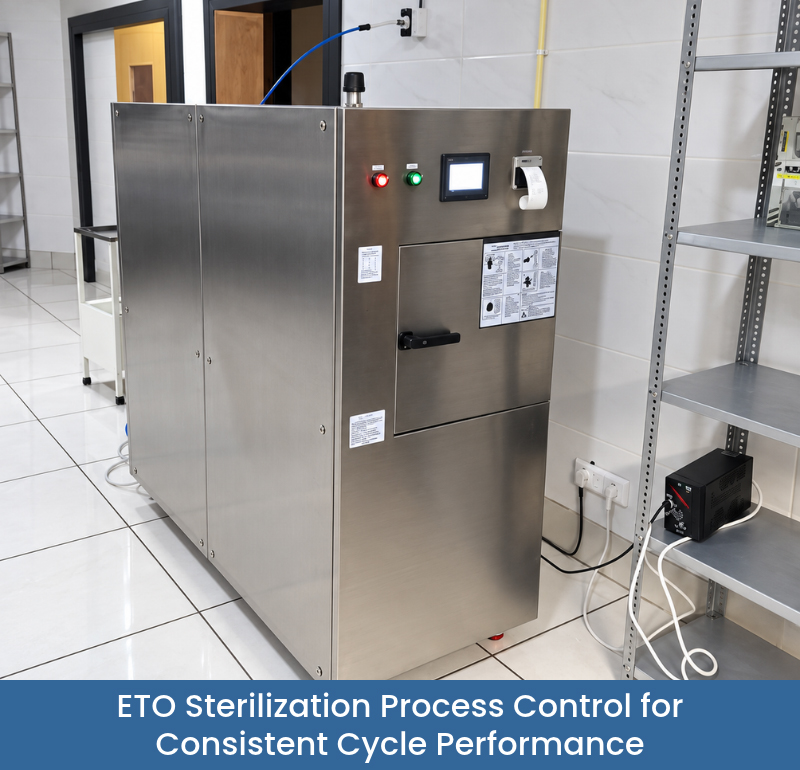
Define required cycle stages and monitored variables, including temperature, pressure, vacuum, conditioning or humidity where applicable, EO admission, exposure and aeration. State which operations must be automatic and which manual controls are permitted.
Specify recipe approval, user levels, alarm acknowledgement, interrupted-cycle handling, sensor identification and calibration. The company’s published equipment features include automatic progression through vacuum, exposure, sterilising and aerating phases, with control-panel indication and parameter control. Actual settings must be established and validated for the intended load.
ETO Sterilizer Utility and Installation Requirements
List electrical supply, compressed air, water or steam where relevant, drainage, ventilation, exhaust and gas supply. Include room dimensions, access, environmental conditions, floor constraints and required facility-system interfaces.
Require a configuration-specific utility schedule covering connections, service quality, pressure or capacity and consumption. Allocate responsibility for bringing utilities to each connection point.
ETO Sterilizer Safety Features and Operator Protection
Required ETO sterilizer safety features should follow the site risk assessment, local law and occupational-exposure obligations. Consider door interlocks, leak checks, pressure and vacuum safeguards, emergency stops, gas controls, alarms, access restrictions, exhaust interfaces and safe release conditions.
Published equipment features include negative-pressure operation, leak testing, aeration, alarms and interlocks on applicable configurations. Request the exact arrangement for the selected configuration. Also define signage, emergency procedures, exposure controls and safety training.
EO Sterilizer Specification for Automation and Data Traceability
State the parameters recorded, batch and operator identification, alarm and event history, timestamps, trend displays, report format, export, retention, backup and access management.
If integration with another system is required, name the interface and required data exchange. The company’s industrial sterilizer information states that detailed reports and graphs can be stored on a pen drive. Buyers requiring extended storage, network integration or controlled electronic records should identify these needs explicitly and obtain written confirmation.
ETO Sterilizer Documentation, Testing and Qualification Support
Specify required drawings, datasheets, utility schedules, component and instrument lists, applicable certificates, manuals, safety information and recommended spares at each project stage.
Define scope and acceptance criteria for the Factory Acceptance Test and Site Acceptance Test. State required support for Installation Qualification or Operational Qualification and the associated records. The package must fit the buyer’s quality system, with responsibility for product validation and regulatory submissions clarified separately.

ETO Sterilizer Procurement Scope and Buyer Responsibilities
Prepare a responsibility matrix covering supply, delivery, positioning, installation, utilities, commissioning, testing, qualification support, cycle development, validation, training, site readiness, consumables, spares and maintenance.
Warranty should be requested as a defined commercial term: start date, duration, inclusions, exclusions and response arrangement. The company publishes a 24-month warranty from installation and commissioning for its table-top and fully automatic models, subject to confirmation in the specific quotation.
Practical ETO Sterilizer URS Checklist
| Requirement Category | Information the Buyer Should Define | Supplier Response Required |
|---|---|---|
| Product and load | Materials, packs, dimensions and load patterns | Suitability and assumptions |
| Capacity and throughput | Batches, shifts and future volume | Achievable throughput basis |
| Chamber configuration | Usable volume, access and door workflow | Offered chamber and arrangement |
| Process control | Stages, variables, modes and recipes | Control philosophy and deviations |
| Utilities | Available services and connection points | Demand and connection schedule |
| Safety | Risk-based interlocks, alarms and interfaces | Included safety provisions |
| Automation and data | Records, reports, retention and export | Functions, formats and limitations |
| Documentation | Drawings, manuals and certificates | Document register |
| Testing and qualification | FAT, SAT, IQ and OQ expectations | Scope and exclusions |
| Installation and training | Site work, commissioning and users | Responsibility and duration |
| Maintenance and spares | Service plan and critical spares | Recommended schedule and list |
Common ETO Sterilizer URS Preparation Mistakes
- Copying another facility’s URS can import irrelevant constraints.
- Selecting nominal chamber volume before studying the load can create poor utilisation.
- Asking for a “fully automatic” unit without defining functions leaves room for different interpretations.
- Ignoring forecast demand can shorten the useful capacity horizon.
- Omitting utilities, ventilation, exhaust or gas-storage interfaces can delay installation.
- Mixing mandatory requirements with preferences makes technical evaluation unclear.
- Leaving qualification and document deliverables undefined creates late scope disputes.
- Assuming product validation is automatically included can leave a critical responsibility unassigned.
- Comparing only headline capacity can hide differences in usable space, data, safety and supplier scope.
- Prescribing unnecessary design details can exclude a valid alternative without improving the outcome.
Evaluating ETO Sterilizer Quotations Against the URS
Require bidders to mark every clause as complies, partially complies, does not comply, alternative proposed or clarification required. Review supporting notes rather than accepting an unqualified compliance statement. Create a deviation register covering optional items, exclusions, utility assumptions, documentation, testing and division of responsibilities.
Resolve significant deviations before technical approval and ensure accepted alternatives are incorporated into the final specification. Commercial comparison should begin only after the technical scope has been normalised; otherwise, a lower quotation may simply exclude work included by another supplier.
Sterility Equipment India Private Limited: ETO Sterilizer Manufacturer in India
Sterility Equipment India Private Limited, based in Ahmedabad, supplies table-top, fully automatic and Industrial ETO Sterilizers for hospitals, medical-device manufacturing, life sciences, tissue banks and test laboratories. Its published equipment information includes stainless-steel chamber options, automatic cycle control and industrial single- or double-door configurations. Prospective buyers can discuss their product, chamber, workflow and project requirements with the company before requesting a configuration-specific proposal.
Conclusion: Preparing a Complete ETO Sterilizer URS
A URS should be approved before quotations are requested. Product and load data should guide capacity and throughput, while site utilities, safety, control, records and documentation should be defined early enough to affect the proposed solution. Clear boundaries between supplier work and buyer responsibilities reduce scope gaps. Finally, a clause-by-clause compliance review allows buyers to assess comparable technical offers rather than relying on price or headline chamber capacity alone. Sterility Equipment India Private Limited can discuss the intended sterilisation application and prepare a proposal against the buyer’s documented requirements.