

IQ OQ PQ validation is among the most critical compliance requirements for any pharmaceutical manufacturer, medical device company or healthcare facility operating an ETO sterilizer. Before an ETO sterilization machine can be used in regulated production environments, it must undergo a structured equipment qualification process that confirms the machine is installed correctly, operates as intended and consistently delivers the required sterility outcomes. This three-phase framework – Installation Qualification (IQ), Operational Qualification (OQ) and Performance Qualification (PQ) – forms the backbone of sterilization validation protocol across global regulatory standards including ISO 11135, ISO 13485 and FDA 21 CFR Part 820.
For manufacturers and end-users of ethylene oxide sterilization equipment, this guide breaks down what each qualification phase entails, why it matters and how investing in a correctly engineered ETO sterilizer simplifies the entire validation journey.
ETO Sterilizer Qualification: Why IQ OQ PQ Validation Cannot Be Skipped
Ethylene oxide sterilization is used extensively for heat-sensitive medical devices, surgical instruments and pharmaceutical components that cannot withstand steam or dry-heat sterilization. Because ethylene oxide (EO/ETO) is a highly reactive gas that directly impacts product sterility assurance, regulatory bodies worldwide require documented proof that every EO sterilization machine functions within defined and validated parameters – every single time it runs a cycle.
Without a completed sterilization validation protocol, facilities cannot release sterilized products for use in hospitals, surgical centers or diagnostic labs. Non-compliance risks product recalls, regulatory penalties and – most critically – patient safety events. The IQ OQ PQ framework provides the structured, documented evidence trail that regulators require and that quality teams depend on.
 Email Us Today!
Installation Qualification (IQ): Confirming the ETO Sterilization Machine Is Correctly Set Up
The Installation Qualification phase is the first stage of EO sterilizer qualification. IQ systematically verifies that the ethylene oxide sterilizer has been delivered, installed and configured according to the manufacturer’s specifications and the facility’s design requirements. The IQ protocol documents everything that can be verified at the point of installation, before the machine is powered on for operational testing.
Key elements covered in the IQ phase include:
- Verification of equipment model, serial number and manufacturer documentation against the purchase order and design specifications
- Confirmation that the sterilization chamber, door seals, vacuum system, humidity control and gas injection components are installed per technical drawings
- Review of utility connections – electrical supply, compressed air, steam generator for humidity and gas exhaust/abatement lines – against required specifications
- Documentation of all installed instruments and sensors, including calibration certificates for temperature, pressure and relative humidity sensors
- Confirmation of safety systems including leak test functions, aeration systems and emergency shutdown controls
- Review of vendor-supplied manuals, drawings, spare parts lists and preventive maintenance schedules
A well-engineered ETO sterilizer – built with stainless steel internal chambers, clearly labeled utility connections and pre-wired control panels – significantly reduces the time and effort required to complete a thorough IQ. ETO sterilizer Equipment that ships with complete documentation packages, calibration records and traceable component certificates makes the IQ phase far more straightforward for validation teams.
Read Our Article
ETO Sterilization Innovation & Future TrendsOperational Qualification (OQ): Validating That EO Sterilizers Perform Within Specified Limits
Once IQ is complete, the Operational Qualification phase tests the ETO sterilization machine under defined operating conditions to verify that it functions as intended across its full operational range. OQ is executed with challenge conditions – often at the edges of the specified operating parameters – to confirm the machine can maintain acceptable performance under worst-case scenarios.
The OQ for an ETO sterilizer typically involves:
- Temperature distribution studies across the sterilization chamber to verify uniformity during pre-conditioning, gas dwell and aeration phases
- Vacuum system performance testing to confirm the sterilizer achieves and maintains the specified vacuum levels required for gas penetration
- Relative humidity (RH) control verification – confirming the steam generator delivers and maintains the humidity range specified for ethylene oxide sterilization efficacy
- EO gas concentration and exposure time verification to confirm the correct gas dosage is delivered in each cycle
- Cycle phase progression testing – verifying that pre-conditioning, exposure, vacuum, aerating and sterilizing phases advance correctly and automatically as programmed
- Alarm and interlock testing – confirming that the control system responds correctly to parameter excursions, including leak test failures and power interruptions
- Data logging verification – confirming that cycle parameters are correctly recorded in reports and stored digitally (e.g., pen drive storage on the machine)
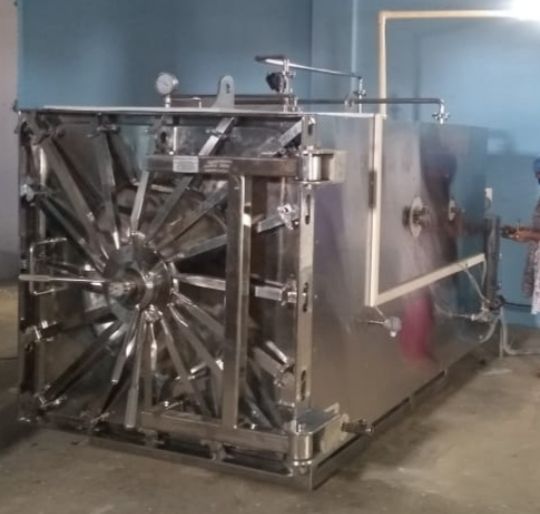
Industrial ETO sterilizers equipped with a fully automatic control panel are particularly well-suited for OQ testing because the control system manages and records each phase independently. The control panel’s screen indicates each sterilization phase in real time and detailed cycle reports – including graphical data – are stored automatically, providing the documentation evidence required to close OQ protocols efficiently.
Our Other Product
Table Top ETO SterilizerPerformance Qualification (PQ): Proving ETO Sterilization Delivers Consistent Sterility Assurance
Performance Qualification is the final and most operationally significant phase of sterilization validation. While IQ confirms correct installation and OQ confirms operational function, PQ demonstrates that the ETO sterilizer consistently achieves the required sterility outcomes when processing actual product loads under real-world conditions. PQ is performed using the actual product, actual load configurations and actual cycle parameters that will be used in routine production.
The PQ protocol for EO sterilizers typically includes:
- Biological indicator (BI) studies – placing standardized biological challenge organisms (typically Bacillus atrophaeus spores) throughout the product load and verifying complete kill across all locations
- Half-cycle or overkill studies – running a fractional cycle and confirming sub-lethal conditions still achieve a defined SAL (Sterility Assurance Level) with the remaining BI population
- Load configuration studies – confirming that product placement, packaging density and pallet or basket arrangement do not adversely affect gas penetration or cycle uniformity
- EO residue testing – sampling processed products for ethylene oxide and ethylene chlorohydrin (ECH) residues to verify compliance with ISO 10993-7 biocompatibility limits
- Repeatability runs – completing a minimum of three consecutive successful cycles (often specified by the regulatory framework or the facility’s validation master plan) to demonstrate process consistency
The PQ phase is where the EO sterilization machine’s design truly matters. Sterilizers with chambers that support both positive and negative pressure, with precisely controlled aeration systems that reduce EO gas exposure for operators and with verified humidity control using dedicated steam generators, are inherently more likely to deliver repeatable, validated results. Chamber geometry and size also influence load distribution – larger industrial chambers with validated uniform temperature and gas profiles reduce the PQ effort required.
Read Our Article
Latest Insights in ETO Sterilizer Technology and Automation
Sterilization Validation Protocol: Key Standards Governing ETO Sterilizer Qualification
ETO sterilizer qualification is governed by a framework of international standards that define the technical requirements for each phase of the IQ OQ PQ process. Understanding which standards apply is essential for building a validation protocol that satisfies both domestic regulatory requirements and international market access requirements.
The primary standards relevant to ethylene oxide sterilization validation include:
- ISO 11135:2014 – Sterilization of health-care products: Ethylene oxide – Requirements for the development, validation and routine control of a sterilization process for medical devices. This is the primary reference standard for ETO sterilization validation worldwide.
- ISO 13485:2016 – Medical devices quality management systems, which requires that all sterilization processes used in medical device manufacturing be validated and controlled.
- ISO 10993-7 – Biological evaluation of medical devices: Residual EO and ECH limits, critical for the PQ phase and ongoing routine monitoring.
- FDA 21 CFR Part 820 (Quality System Regulation) and the harmonized EU MDR requirements, both of which require documented sterilization process validation for medical device manufacturers.
- CPCB and applicable national environmental regulations governing ETO gas emissions and abatement systems – relevant to IQ documentation of exhaust and scrubbing systems.
Facilities purchasing new EO sterilizers should confirm that the equipment manufacturer provides validation support documentation – including design qualification (DQ) records, factory acceptance test (FAT) reports and calibration certificates – that align with these standards. This documentation forms the starting point for the facility’s own IQ protocol.
Our Other Product
Industrial ETO Sterilizer MachineETO Sterilization Machine Design Features That Support Validation Success
Not all ethylene oxide sterilizers are equally validation-friendly. The design, build quality and control system sophistication of the sterilization machine directly impact how efficiently the IQ OQ PQ process can be completed – and how reliably the machine can be re-validated after changes.
Features that materially support validation outcomes include:
- Fully automatic control systems that independently manage and document all cycle phases – pre-conditioning, gas dwell, vacuum, aeration and sterilizing – reducing manual intervention variables during OQ and PQ
- Integrated data logging that stores detailed cycle reports and graphical parameter trends to a pen drive or digital record system, providing the audit trail required by IQ and OQ documentation
- Dedicated steam generator for each model to ensure accurate and consistent relative humidity – a parameter directly tied to ETO sterilization efficacy and a critical OQ test point
- Stainless steel chamber construction for both doors and internal surfaces, supporting cleanability, longevity and consistent thermal performance across validation cycles
- Single or double door configurations, matched to facility workflow requirements, since the door design impacts load transfer protocols documented in IQ
- Integrated leak test function that prevents the ethylene oxide sterilizer from starting without a confirmed vacuum seal – directly supporting both safety and the cycle integrity requirements tested during OQ
- Chamber designs supporting positive and negative pressure operation, expanding the range of load configurations and products that can be validated on the equipment
- Aeration systems engineered to minimize operator EO gas exposure – an occupational health requirement that must be documented in IQ and verified in OQ
ETO Sterilizer Qualification Support from Sterility Equipment India Private Limited
Sterility Equipment India Private Limited, based in Ahmedabad, Gujarat, is a dedicated manufacturer and exporter of industrial ETO sterilizers, fully automatic ETO sterilizers and table-top ETO sterilizers for hospitals, medical device manufacturers, research laboratories and life science facilities. Founded in 2014, the company has built its reputation on delivering EO sterilization machines that are engineered for consistent performance and are designed with the features that regulated industries need to complete sterilization validation efficiently.
The company’s industrial ETO sterilizer machines feature fully stainless steel chamber construction, fully automatic control panels with real-time phase indication, integrated steam generators, dedicated aeration systems, leak test functions and digital data logging – all of which directly address the most time-intensive elements of IQ OQ PQ protocols. Available in chamber sizes ranging from 45 CFT to 720 CFT, with both single-door and double-door configurations, Sterility Equipment’s range covers everything from tabletop hospital sterilizer applications to large-scale industrial EO sterilization for medical device and life science manufacturing.
Sterility Equipment’s machines are used across sectors including medical device manufacturing, tissue banks, test labs, animal research facilities, PPE kit sterilization and herbal and spices processing. The company supports customers with technical documentation, equipment specifications and the supplier-side records that form the foundation of a robust IQ package. For facilities in the pharmaceutical and medical device industries where ETO sterilizer qualification is a regulatory requirement, Sterility Equipment’s engineering and documentation approach reduces the qualification burden from the start.
Conclusion: Building Confidence with IQ OQ PQ Validation in Every ETO Sterilization Cycle
IQ OQ PQ validation is not a one-time administrative exercise – it is the documented foundation of sterility assurance for every product that passes through an ETO sterilizer. Installation Qualification establishes that the sterilization equipment is correctly set up and documented. Operational Qualification confirms that the EO sterilizer performs within its specified parameters under defined test conditions. Performance Qualification demonstrates that the machine consistently delivers the required sterility outcomes with actual product loads. Together, these three phases of ETO sterilizer qualification give manufacturers, regulators and end-users the confidence that ethylene oxide sterilization is being performed reliably, safely and in compliance with international standards. Choosing sterilization equipment that is purpose-built with validation in mind is the most effective way to streamline this process – from the first IQ document to the final PQ batch record.