

Sterilization Challenges in Gaza: Safer Medical Device Reprocessing is Crucial Settings
Gaza’s medical crisis has turned device reprocessing into a frontline issue rather than a background technical task. In hospitals managing blast injuries, crush trauma, burns, contaminated wounds and repeat emergency procedures, the ability to return instruments safely to use can shape what happens in the operating room just as much as staffing or bed availability. The problem is not simply whether hospitals possess Sterility Equipment. The deeper problem is whether reprocessing systems can keep pace when trauma volume rises, utilities fail, surgical schedules overflow and instrument sets circulate too quickly between one patient and the next. In that setting, medical devices sterilization is tied directly to infection control, surgical timing and patient survival.
The pressure is especially severe because Gaza’s hospitals are not dealing with routine case flow. They are dealing with repeated contamination-heavy surgeries, incomplete supply access, damaged infrastructure and exhausted teams working under constant clinical compression. That is why conversations about medical sterilizers and the place of an Ethylene Oxide Sterilizer must stay rooted in operational reality. The issue is not convenience. It is whether a facility can process devices safely enough to avoid turning scarce medical tools into another source of risk in high-trauma care.
 WhatsApp Us
Ethylene Oxide Sterilizer in the Context of Gaza’s Trauma Burden
An Ethylene Oxide Sterilizer becomes relevant in Gaza because trauma care often depends on devices that are difficult to process through one standard pathway. Surgical teams may rely on plastics, tubing, mixed-material components and narrow internal channels that do not respond well to harsh heat or rushed reuse. In a stable hospital, that complexity is manageable. In Gaza, where operating rooms may face one contaminated case after another, those device characteristics become part of the emergency itself. Reprocessing choices can no longer be made in a calm, controlled rhythm. They happen under pressure and that pressure increases the danger of unsafe shortcuts. This matters because high-trauma care is rarely one operation and done. Gaza’s patients often need serial debridement, follow-up wound exploration and repeated access to the same limited pool of tools. When a facility lacks flexibility in reprocessing, clinical care starts bending around equipment constraints. A tray is delayed. A device is held back. Another instrument is used instead because the ideal one is not ready. That is how reprocessing delays begin influencing treatment decisions. In Gaza, faster turnover only helps when safety holds from cleaning to final release. Otherwise, speed creates false reassurance rather than real sterility.
Medical Sterilizers under Pressure from Repeated Emergency Surgery
Medical sterilizers in Gaza are working inside a chain that is already strained before a load ever enters a chamber. Instruments have to be collected from theatre, separated, cleaned, inspected, packed, processed and returned under conditions that may include water interruptions, unstable electricity, overcrowded work areas and severe staff fatigue. In high-trauma settings, the sterilizer is not the only bottleneck. The bottleneck is the entire reprocessing pathway. A medical sterilizer machine can complete a cycle, yet the hospital may still fall behind because contaminated sets keep arriving faster than they can be safely prepared.
This is where the difference between technical capacity and usable capacity becomes obvious. A facility may own a medical equipment sterilizer, but if instrument inventory is thin and clinical demand is relentless, safe turnaround remains difficult. Gaza’s hospitals often need the same devices back in circulation quickly, especially in orthopedics, general trauma surgery and wound management. That can create pressure to compress timelines that should not be compressed. The result is not always dramatic at first. Sometimes it appears as delays, missing components or heavy dependence on substitute tools. Over time, though, the gap between demand and safe processing turns into a patient safety threat.
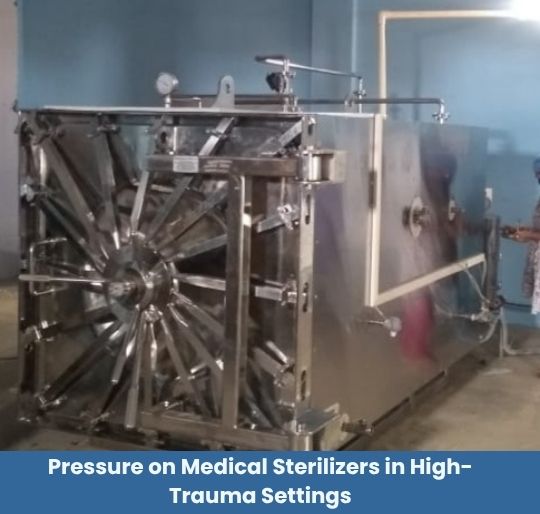
Ethylene Oxide Sterilization for Heat-Sensitive Devices in Critical Care
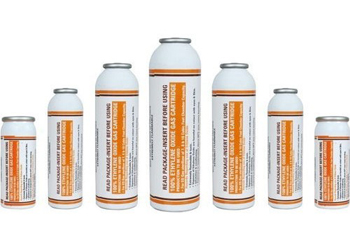
Ethylene Oxide Sterilization has a specific place in Gaza because not every device used in trauma and critical care can tolerate standard heat-based processing. Some components required for emergency intervention are sensitive to temperature, moisture or repeated thermal stress. In such cases, EO Sterilization may become necessary options for selected items that must remain functional despite repeated clinical demand. That does not make the method simple or fast in practice. It makes it important when the device mix is complex and replacement access is uncertain.
The relevance of ETO for sterilization becomes clearer in hospitals where heat-sensitive tools cannot simply be discarded after limited use. Gaza’s clinical environment increases dependence on whatever compatible items can be kept safely in service. That is where ETO sterilization uses matter, particularly for components with lumens, plastics or mixed materials that require careful handling. Still, this method is only useful when the full system around it works properly. ETO gas sterilization cannot rescue poorly cleaned devices or compensate for disorganized workflow. In Gaza, the process is valuable precisely because the stakes are high, not because it offers an easy shortcut.
ETO Sterilization Procedure during Mass-Casualty Disruption
The ETO sterilization procedure is demanding under normal hospital conditions. In Gaza, it becomes even harder because every stage must survive the pressure of mass-casualty care. Proper cleaning, drying, packaging, loading, exposure control and release discipline all remain necessary even when staff are exhausted and incoming trauma cases keep rising. That is why the ETO sterilization process cannot be treated as a quick reset tool for devices that are urgently needed back in circulation. It requires time and control at the exact moment the clinical environment offers the least of both.

This is also where ETO process sterilization and the role of protocols become strategically important. Hospitals need clear rules on which devices are compatible, which cannot be rushed and how to avoid premature reuse. In Gaza, protocol failure can happen quietly. A load may be processed, but the surrounding workflow may still be too disrupted to guarantee safe release. The same is true for documentation and handoff. When the hospital is operating in crisis mode, the greatest danger is assuming that completion of one step means the whole chain is secure. In trauma care, that assumption can have immediate consequences for the next patient.
EO Sterilizer Planning Amid Supply Limits and Reprocessing Gaps
An EO Sterilizer in Gaza is not just a procurement decision. It sits inside a larger question about access, maintenance, compatibility, staffing and whether specialized reprocessing can actually function in a disrupted medical environment. The challenge is not solved by discussing an ETO sterilizer machine in isolation. Hospitals also face blocked supply pathways, limited spare parts and uneven technical support. Under those conditions, a reprocessing gap can widen even when the need for specialized capacity is clear.
That is why conversations around ETO sterilization machine price should never dominate the clinical picture. In Gaza, the real issue is whether hospitals can avoid unsafe workarounds when reprocessing choices are narrow and trauma demand is unrelenting. A device that should go through a specific pathway may instead be delayed, improvised around or pushed through a less suitable process because the system is under strain. The cost of failure is not just operational. It appears in infection risk, interrupted care and the loss of already scarce clinical options.
Sterilization Medical Devices as a Frontline Safety Issue in Gaza
Sterilization medical devices is not a side topic in Gaza; it is part of frontline trauma readiness. The pressure on hospital sterilization systems rises with every contaminated wound, every repeat operation and every shortage of clean instrument sets. When that pressure overwhelms the process, the problem reaches far beyond the reprocessing unit. Surgeons begin adapting plans to available trays. Nurses manage around delayed equipment. Patients enter procedures in a system that may already be stretched past safe margins. This is why medical sterilizers and method-specific pathways matter not as isolated technology choices, but as part of the hospital’s ability to keep care safe under constant trauma load.
Gaza’s challenge is not a lack of awareness that sterility matters. It is the brutal mismatch between clinical demand and the fragile conditions required for reliable reprocessing. Whether the method involves steam, an Ethylene Oxide Sterilizer or another specialized pathway, the central issue remains the same: devices must return to care only when the process is complete, controlled and trustworthy. In a setting where the next emergency is never far away, safe reprocessing is one of the few barriers preventing trauma care from becoming even more dangerous than it already is.
Conclusion
Gaza’s sterilization crisis is really a trauma-capacity crisis seen through the lens of device reprocessing. When instrument turnover slows, when heat-sensitive tools lack the right pathway or when overloaded hospitals blur the line between processed and safe, patient risk rises fast. Faster reprocessing matters, but only when it remains disciplined from cleaning through release. That is why medical devices sterilization and tightly managed specialized workflows are critical in Gaza’s high-trauma hospitals. In this setting, safer reprocessing is not a technical luxury; it is part of emergency care itself.