

An ethylene oxide sterilization cycle transfer may become necessary when a manufacturer adds capacity, replaces ageing equipment, moves production, establishes a backup location or appoints a contract sterilization provider. Although the programmed recipe may be transferable, its proven performance is not automatically transferable. Chamber geometry, control logic, utilities, environmental conditions and load presentation can change the conditions experienced by the product. For that reason, sterilization with ethylene oxide requires more than entering the original setpoints into another chamber. The transfer team must compare the validated process with the proposed receiving process, identify meaningful differences and establish suitable evidence before routine use. This risk-based approach protects process control while avoiding the unsupported assumption that similar equipment will necessarily produce equivalent results.
Why an EO Cycle May Need to Be Transferred
An ETO cycle transfer may support capacity expansion, equipment modernisation, relocation, outsourcing or business continuity. A manufacturer might install a second ethylene oxide sterilization machine, replace an existing unit or qualify another facility. Whether the project remains within one quality system or moves to a contract processor, the team must assess EO sterilizer equivalence, determine the necessary EO chamber qualification activities and establish whether partial or full ETO process revalidation is required.
A sterilization site transfer also introduces new procedures, responsibilities and facility conditions. The project should therefore begin by defining the reason for the transfer, products and loads involved, original and receiving chambers, participating locations and intended implementation date. A reduced validation approach should not be selected before the technical differences and associated risks have been evaluated.
 Email Us Now!
Defining the Original Validated EO Process
The starting point is a controlled description of what the original ethylene oxide sterilization process validated. This includes the approved product or product-family boundaries, packaging configuration, loading pattern, load density and orientation, plus preconditioning and aeration arrangements where applicable. The team should retrieve qualification records, operating ranges, monitoring locations, indicator strategy, acceptance criteria and relevant residual, functionality or packaging evidence.
Cycle records, deviations and previous changes can reveal which parameters or load positions have been sensitive during routine operation. Nominal setpoints describe the instructions given to the equipment, but they do not necessarily represent the conditions demonstrated throughout the product load. This distinction is essential when comparing an existing unit with a proposed ethylene oxide sterilizer machine.
For example, the programmed chamber temperature may match the original recipe while individual product locations respond differently because of load density, circulation or conditioning. The transfer team must therefore understand both the programmed values and the actual process conditions supported by the original validation data.
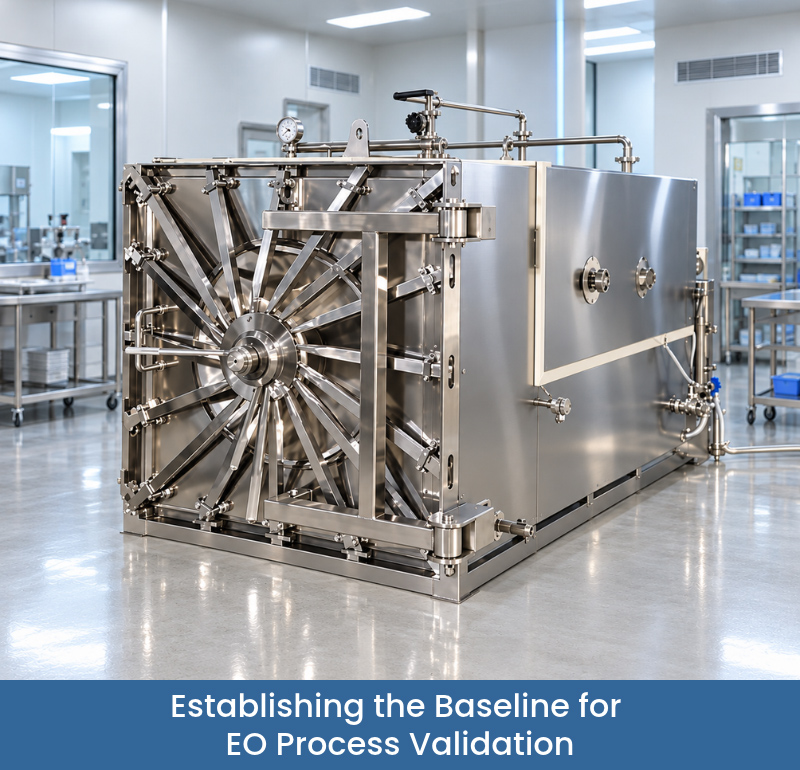
Comparing EO Sterilizer Chamber Design and Equipment
The original and receiving chambers should be compared using approved drawings, equipment specifications, qualification records and engineering review. Relevant characteristics include:
- Chamber volume, geometry and usable loading space
- Door configuration
- Internal circulation characteristics
- Heating and humidification methods
- EO introduction arrangements
- Vacuum-system design
- Gas-removal and air-wash stages
- Sensor types and locations
- Monitoring and recording instruments
- Leak-test capability
- Preconditioning and aeration areas
- Calibration and maintenance status
Similar chamber capacity does not demonstrate EO sterilizer equivalence. Differences in geometry and circulation can affect distribution, while different vacuum or gas-delivery arrangements may change evacuation, penetration and removal behaviour. Even equipment from the same manufacturer or product range may require assessment of its installation, calibration status, utilities and site-specific configuration.
The comparison should clearly distinguish design similarities from demonstrated performance. Where supporting information is unavailable, that uncertainty should be documented rather than treating an assumed similarity as evidence.
Assessing Sterilizer and Control-System Equivalence
The recipe visible to an operator represents only part of the equipment’s control strategy. The assessment should review sequence logic, parameter-control methods, sensor types and positions, data-acquisition frequency, alarm limits, interlocks, phase-transition criteria, timing logic and cycle-interruption behaviour.
Recipe permissions, software versions, user-access controls, electronic records and audit trails should also be examined where applicable. Any claimed function should be supported by approved equipment or software documentation.
Two systems can display identical setpoints but respond differently if their phase transitions, sampling rates, sensor logic or control tolerances differ. The receiving system’s functions must therefore be tested rather than inferred.
Utility and Environmental Differences Between Facilities
The transfer assessment should address the supplies required by the receiving system. Depending on the equipment and installation, these may include electrical power, water, steam, compressed air, ventilation, exhaust and EO supply arrangements. Utility stability during peak production, interruption and recovery may be as relevant as normal availability.
Ambient temperature, humidity, room airflow and pressure should be considered where they can influence the process. The performance of preconditioning and aeration areas may also vary between locations or seasons. Safety and emergency arrangements must meet applicable site and legal requirements.
Utility suitability should be verified under operating conditions instead of being assumed from design specifications. However, the assessment should remain specific to the receiving equipment because not every EO installation uses the same utilities or facility arrangement.
Product, Packaging and Load Equivalence
Product equivalence requires more than confirming that the same catalogue number will be processed. The assessment should compare:
- Product materials, dimensions and complexity
- Lumen characteristics where applicable
- Primary and secondary packaging
- Packaging permeability
- Carton quantity and arrangement
- Pallet or carrier configuration
- Load density and orientation
- Minimum and maximum loads
- Mixed-load restrictions
- Pre-sterilization holding conditions
- Storage and transportation conditions
A change in packaging or load configuration can alter thermal response, moisture conditioning, EO access and subsequent gas removal. Changing the chamber and loading pattern simultaneously may also make it difficult to determine which difference affected performance.
If the proposed configuration falls outside the original validated boundaries, it should be recorded as a separate technical gap. Unchanged product specifications alone do not demonstrate that the load presented to the receiving chamber is equivalent.
Temperature, Humidity, Gas Delivery and Vacuum Performance
The receiving process must establish the required conditions throughout the load, not only at the chamber’s controlling sensor. The assessment should consider chamber distribution, product temperature response, relative-humidity delivery and measurement, equilibration, slow-to-condition locations, sensor placement and relevant load extremes.
Empty-chamber mapping helps characterise the equipment, but it does not independently show how a dense or difficult product load behaves. Loaded studies may be needed based on the transfer risks and existing evidence.
Gas introduction, chamber-pressure response, vacuum and evacuation performance, leakage, circulation and post-exposure removal stages also require comparison. The same nominal EO quantity or programmed pressure does not necessarily create equivalent exposure at every product location.
Acceptance criteria should come from the established process, applicable standards, regulatory requirements and an approved transfer protocol. Generic temperature, humidity, pressure or vacuum values should not be applied without project-specific justification.
Technical Gap Assessment for Ethylene Oxide Sterilization Cycle Transfer
A structured technical gap assessment connects each identified difference with its potential impact on microbiological performance, product functionality, packaging integrity, residual outcomes and process control. It should document the evidence reviewed, remaining uncertainty, risk evaluation, required action, responsible person and acceptance route.
| Assessment Area | Original-Process Evidence | Receiving-Process Evidence | Potential Impact | Required Follow-Up |
| Chamber design | Drawings and qualification records | Receiving-chamber documentation | Distribution or penetration differences | Engineering and validation assessment |
| Control system | Validated sequence and recorded cycle data | Logic, sensors and recording functions | Different control or data capture | Functional comparison and testing |
| Utilities | Qualified supply conditions | Actual receiving-site conditions | Process variation or instability | Site verification |
| Product and packaging | Validated product and pack configuration | Proposed transferred configuration | Changed conditioning or EO access | Equivalence assessment |
| Load configuration | Approved loading pattern | Receiving load arrangement | Different process distribution | Load comparison and challenge evaluation |
| Supporting areas | Preconditioning and aeration evidence | Receiving-site facilities | Changed conditioning or gas removal | Qualification or verification |
A difference should not be accepted merely because it appears minor. Its importance depends on how it could affect the validated state and whether available evidence adequately controls the associated risk.
Verification, Qualification and ETO Process Revalidation
The technical gap assessment should determine the evidence needed before routine processing begins. Depending on the identified risks, activities may include:
- Qualification-record review
- Calibration and utility verification
- Control-sequence testing
- Leak and vacuum-performance testing
- Empty-chamber mapping
- Loaded-chamber distribution studies
- Preconditioning or aeration assessment
- Product and packaging equivalence review
- Microbiological performance studies
- Residual evaluation
- Product-functionality or packaging testing
- Partial or full performance requalification
Significant differences may require formal ETO process revalidation. Verification, equipment qualification, requalification and process revalidation are related activities, but they are not interchangeable.
Commissioning may demonstrate that the equipment is installed and operational, but it does not prove that the transferred product load meets the established process requirements. The required testing programme must be justified from the identified gaps, risk assessment, applicable standards, regulatory obligations and the organisation’s quality system.
ISO 11135:2014, together with Amendment 1:2018, specifies requirements for developing, validating and routinely controlling ethylene oxide sterilization processes for medical devices. AAMI TIR28 is also relevant because it addresses product adoption and process equivalence for EO sterilization, as identified in the FDA recognised consensus-standard record.
These documents provide important technical frameworks, but they do not replace project-specific risk analysis or regulatory assessment. No single number of qualification runs or one testing programme is universally appropriate for every cycle transfer.
Special Considerations for a Sterilization Site Transfer
When processing moves between facilities or organisations, equipment comparison is only one part of readiness. A quality agreement should define responsibilities for:
- Product preparation and transportation
- Receiving inspection
- Pre-sterilization holding time
- Load assembly and cycle operation
- Batch-record review
- Deviation investigation
- Data ownership and retention
- Product release
- Change notification
Controlled documents and product-family definitions must remain aligned between the sending and receiving parties. Equipment-release status, calibration, maintenance systems, training, batch traceability and site procedures should also be verified.
Regulatory teams should assess whether the proposed transfer affects existing registrations, submissions or notification obligations in relevant markets. A technically suitable chamber cannot compensate for unclear data ownership, incomplete traceability or unresolved product-release authority.
Change-Control Documentation for an ETO Cycle Transfer
Formal change control should record the transfer scope, original and receiving equipment, participating facilities, team responsibilities, comparison results, risks, approved protocols and acceptance criteria. Test results, deviations, corrective actions, regulatory assessments, procedural updates, training and final approval should be linked to the change record.
The final decision should be traceable to supporting evidence. A statement that two processes or chambers are “equivalent” is not sufficient unless the documented assessment demonstrates how that conclusion was reached.
Post-Transfer Monitoring of the EO Sterilization Process
After implementation, defined monitoring should review routine cycle records, parameter trends, alarms, deviations, utility interruptions and equipment maintenance. Relevant microbiological, residual, packaging or product observations should also be compared with established expectations where required.
Post-transfer monitoring can identify emerging variation and support continued control. However, it cannot replace the qualification and validation evidence required before approving routine production in the receiving chamber.
Ethylene Oxide Sterilization Cycle Transfer Checklist
- Transfer scope and responsible team defined
- Original validation and routine-performance history available
- Product-family, packaging and load boundaries confirmed
- Original and receiving chambers identified
- Chamber design and control logic compared
- Sensors, monitoring and calibration reviewed
- Utilities and environmental conditions evaluated
- Preconditioning and aeration arrangements assessed
- Temperature, humidity, gas and vacuum performance addressed
- Technical gaps and associated risks documented
- Verification, qualification or revalidation plan approved
- Site responsibilities and regulatory impacts assessed
- Acceptance criteria established
- Deviations investigated and resolved
- Change control approved before routine use
- Post-transfer monitoring planned
Common EO Cycle Transfer Mistakes to Avoid
Avoid copying setpoints without evaluating actual process performance, treating similar chamber capacity as proof of equivalence or comparing only equipment model numbers. Control-system logic, sensor positions, utilities, environmental conditions, preconditioning and aeration should not be overlooked.
Changing both the chamber and load configuration without assessment, relying exclusively on empty-chamber data or treating successful commissioning as process revalidation can create significant evidence gaps. At a contract facility, unclear responsibilities may undermine traceability, deviation handling and product release.
Routine production should not begin while deviations, acceptance decisions or required approvals remain open.
 WhatsApp Now
About Sterility Equipment India Private Limited
Sterility Equipment India Private Limited, based in Ahmedabad, manufactures and supplies EO sterilizers for hospitals and medical colleges, along with industrial ETO sterilizer equipment for applications including medical devices, life sciences, tissue banks and test laboratories.
Organisations planning an additional or replacement ETO sterilizer should clearly communicate their existing chamber arrangement, product and load requirements, utilities, process expectations, control requirements and division of qualification responsibilities when discussing the equipment with the company.
Conclusion
A defensible transfer begins with an accurate definition of the validated process and a documented comparison of the original and receiving systems.
The technical gap assessment should connect each difference with the verification, qualification or revalidation evidence required. When processing moves between facilities, clear quality and regulatory responsibilities are also essential. Formal change control, resolved deviations and authorised approval must be completed before routine use.
Manufacturers planning an additional, receiving or replacement chamber can contact Sterility Equipment India Private Limited to discuss EO sterilizer configuration and project requirements.