

EO residue testing is a non-negotiable safety requirement in modern ethylene oxide sterilization workflows. While the sterilization cycle itself – carried out inside an ETO sterilizer – effectively eliminates microbial life from heat-sensitive medical devices and instruments, the process does not end when the gas dwell phase concludes. Residual ethylene oxide trapped within device materials, packaging and lumens poses a direct toxicological risk to patients and healthcare workers. This is why the ETO aeration process that follows sterilization is as technically important as the sterilization cycle itself and why ISO 10993 EO residuals compliance forms the cornerstone of responsible post-sterilization validation.
Ethylene Oxide Sterilization and the Problem of Residual Gas
Ethylene oxide sterilization is widely used in the healthcare and medical device industries because EO gas can penetrate packaging materials and complex device geometries that moist heat or gamma radiation cannot reliably reach. ETO sterilization machines operate by introducing ethylene oxide gas – often mixed with nitrogen or CO₂ – into a sealed, pressure-controlled chamber. The gas infiltrates the product load, disrupting the DNA and protein structures of microorganisms through alkylation, rendering them non-viable. This makes EO sterilization machines indispensable for devices incorporating electronics, rubber components, optical systems and plastics that would be damaged by high-temperature steam sterilization.
However, the same penetrating properties that make ethylene oxide an effective sterilant also cause it to absorb into device materials. Polymers such as PVC, silicone and polyethylene can absorb and retain EO gas well beyond the conclusion of the sterilization dwell period. Without rigorous aeration and validated EO residue testing, devices released for clinical use may carry ethylene oxide levels that exceed safe limits, causing mucosal irritation, chemical burns or systemic toxicity in patients.
ISO 10993 EO Residuals: The Regulatory Framework for Safe Limits
ISO 10993 EO residuals – specifically addressed under ISO 10993-7 – defines the tolerable limits for ethylene oxide and its primary reaction by-product, ethylene chlorohydrin (ECH), in medical devices. The standard classifies devices by contact type and contact category, applying progressively stricter residual limits for devices with greater intimacy of contact or longer duration of patient exposure.
For a device with prolonged patient contact, for instance, the allowable EO residual is capped at 2 mg per device, with a tolerable contact limit of 0.1 mg/day. For implantable devices, the limits are substantially lower. ISO 10993-7 also requires manufacturers to account for cumulative EO exposure when a patient may be simultaneously exposed to multiple sterilized medical devices. These thresholds make validated EO residue testing an absolute requirement before market release for any device processed through an EO sterilization machine.
ETO Aeration Process: How Residual Gas Is Safely Eliminated
The ETO aeration process – also referred to as the degassing stage – is the third and final phase in a complete ethylene oxide sterilization cycle. Following pre-conditioning (temperature and humidity preparation) and the sterilization gas dwell period, the product load is moved into an aeration environment where controlled temperature, airflow and time work together to drive residual EO out of the device materials. In fully automated ETO sterilizers, the degasser cell maintains a precisely regulated temperature – typically between 40°C and 60°C – along with sufficient air exchange rates to accelerate off-gassing without compromising the sterile barrier.
The duration of the ETO aeration process varies considerably based on device material composition, packaging configuration and the mass of EO absorbed during the sterilization dwell. Dense polymer materials or multi-layered packaging that allowed deep gas penetration require proportionally extended aeration periods. Industrial-scale EO sterilizers commonly run aeration cycles spanning 24 to 72 hours or more for polymer-heavy device loads. Abbreviated aeration represents one of the most significant compliance risks in EO sterilization operations, as devices may appear visually ready for release while still carrying unacceptable residual levels internally.
EO Residue Testing Methods: Analytical Approaches to Compliance Verification
EO residue testing after aeration is conducted using validated analytical chemistry methods, most commonly headspace gas chromatography (HS-GC). In this technique, a representative sample of the sterilized device – or an extraction of the device materials – is sealed in a headspace vial and heated to volatilize any trapped EO. The released gas is then injected into a gas chromatograph equipped with a flame ionisation detector (FID), which quantifies EO and ECH concentrations against calibration standards. Results are expressed in milligrams per device or milligrams per surface area, enabling direct comparison against the ISO 10993-7 threshold applicable to that device category.
Manufacturers must demonstrate through a validated residual extraction study that the testing method achieves adequate recovery efficiency from the device material in question. Recovery studies are a prerequisite for regulatory submission in markets governed by ISO 10993 EO residuals requirements, including CE-marked products in Europe and 510(k) submissions reviewed by the United States FDA. Where a device contains multiple material types with different sorption characteristics, worst-case material extraction studies may be required to ensure the most retentive component is adequately tested.
ETO Sterilizer Design and Its Role in Aeration Efficiency
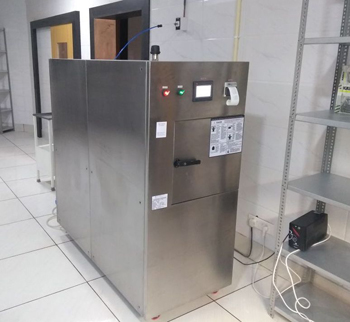
The design and engineering of the ETO sterilization machine directly influences both the efficiency of the sterilization cycle and the ease with which residuals can subsequently be driven off during aeration. Modern EO sterilizers – particularly fully automatic and industrial ETO sterilizer machines – incorporate dedicated degassing chambers with precise temperature uniformity, forced-air circulation and programmable aeration cycle parameters. These engineering features are not incidental; they are critical to ensuring that the ETO aeration process completes within a predictable timeframe and delivers consistently low residual levels across every batch.
In contrast, inadequately designed sterilization equipment that lacks proper temperature control or chamber uniformity during aeration may produce inconsistent residual outcomes, requiring extended aeration periods or repeated testing. The automation and process control capabilities built into advanced ETO sterilizer machines – including batch reporting, temperature logging, real-time phase monitoring and auto-batch release on tolerance deviation – provide the traceability infrastructure that quality-conscious medical device manufacturers require to satisfy regulatory inspectors and notified body audits.
Our Other Product
Fully Automatic ETO SterilizerEO Sterilizers for Hospital and Industrial Applications: Risk Considerations
EO sterilizers for hospital settings and large-scale industrial sterilization plants present distinct residual risk profiles. In hospitals, EO sterilizers typically process smaller, lower-mass loads – surgical instruments, endoscopes and reusable device sets – where complete aeration can often be achieved within the machine’s built-in aeration cycle without off-site degassing. Table-top ETO sterilizer models used in surgical centres, eye care clinics orthopaedic units and ENT departments are specifically engineered for this kind of small-load, high-frequency operation, with aeration parameters set to meet the residual limits applicable to the instruments being processed.
Industrial ETO sterilization machine deployments – serving medical device contract sterilization, tissue banks and life science product manufacturers – handle large pallet-scale loads of single-use devices packaged in multi-layer materials. The residual loading from such batches is substantially higher and the aeration phase must be planned, validated and monitored as a standalone process step. Failure to validate the aeration cycle for specific product-package combinations is a recurring deficiency noted in regulatory inspection reports, making EO residue testing a persistent focus area for quality assurance teams in device manufacturing environments.
EO Sterilization Machine Selection and Aeration Validation: Practical Guidance
Selecting the correct ETO sterilization machine for a given application requires consideration of the device types being processed, anticipated batch volumes, packaging materials and the regulatory framework governing the end market. Manufacturers procuring an EO sterilization machine should verify that the equipment supports programmable aeration cycle parameters and provides the temperature uniformity data needed to support ISO 10993 EO residuals validation. The sterilization equipment supplier should be able to provide installation qualification (IQ) and operational qualification (OQ) documentation as a baseline for the user’s process qualification (PQ) studies.
For organisations conducting EO residue testing for the first time or transitioning to a new ETO sterilizer model, a full validation campaign is strongly recommended – including material-specific sorption and desorption studies, aeration cycle optimisation and worst-case load configuration testing. Engaging with an equipment manufacturer that understands the regulatory context of ISO 10993 EO residuals is an important starting point for ensuring that the ETO aeration process is correctly integrated into the overall sterility assurance system.
 Email!
Sterility Equipment India: ETO Sterilizers Engineered for Residual Control
Sterility Equipment India Private Limited, founded in 2014 and headquartered in Ahmedabad, Gujarat, is an established manufacturer and exporter of EO sterilizers for hospitals, medical institutions, research laboratories, tissue banks and industrial life science applications. The company’s product line spans table-top ETO sterilizers for clinic and surgical centre use, fully automatic ETO sterilizers for medical colleges and mid-scale hospital networks and industrial ETO sterilizer machines designed for high-throughput medical device and PPE sterilization. All Sterility Equipment systems are engineered to support the three-phase ethylene oxide sterilization process – pre-conditioning, sterilization gas dwell and degassing/aeration – with automation features that enable precise cycle control, real-time phase monitoring and batch report generation critical to EO residue testing compliance.
Conclusion
EO residue testing is not a post-process formality – it is an integral safety gate in the ethylene oxide sterilization workflow that directly determines patient safety outcomes. The ETO aeration process, supported by well-designed sterilization equipment and validated by ISO 10993 EO residuals-compliant analytical testing, ensures that EO sterilizes medical devices without leaving behind a chemical hazard. Organisations investing in reliable ETO sterilizer machines with built-in aeration and batch documentation capabilities – position themselves to meet regulatory expectations consistently and deliver sterilized products that are as safe chemically as they are microbiologically.