

ETO Sterilization Cycle: Reduce Time without Compromising Sterility Assurance
For operations managers overseeing sterile medical device production, clinical processing or industrial sterilization workflows, cycle time is a constant pressure point. Ethylene Oxide sterilization, while indispensable for heat- and moisture-sensitive devices, has traditionally carried a reputation for long processing windows. However, advances in sterilization equipment design, process engineering and cycle parameter science have made it increasingly viable to reduce EO sterilization time without sacrificing the sterility assurance level (SAL) that regulatory standards demand.
This article explores evidence-based strategies for ETO cycle optimization, the variables that genuinely affect cycle duration and how modern sterilization machines from specialized manufacturers are helping facilities achieve sterilization productivity improvement across healthcare, life sciences and industrial applications.
ETO Sterilization Cycle: Understanding What Drives Time
Before attempting to reduce EO sterilization time, it is essential to understand what the cycle actually consists of. A standard Ethylene Oxide sterilization cycle comprises three principal phases: preconditioning and conditioning, the gas dwell phase and post-sterilization aeration.
Preconditioning involves exposing the load to controlled temperature and humidity to bring product and packaging to the conditions required for EO penetration. The gas dwell phase is when the actual Ethylene Oxide sterilisation occurs, with EO gas permeating the load and achieving microbial kill. Aeration, often the most time-consuming stage, removes EO residues from the product to safe levels dictated by ISO 10993-7 and equivalent regulatory guidance.
Identifying which phase contributes most to your total cycle time is the first step toward targeted sterilization productivity improvement.
ETO Cycle Optimization through Preconditioning Efficiency
Inadequate preconditioning is one of the most common reasons ETO sterilization cycles fail validation or require extended gas exposure to compensate. When product moisture content and temperature are not at target before gas introduction, the EO gas struggles to achieve uniform penetration and kill kinetics slow considerably.
Modern sterilization equipment with integrated preconditioning chambers allows facilities to condition loads to target humidity and temperature before they ever enter the sterilizer machine. Key preconditioning parameters to optimize for faster ETO cycle optimization include temperature (typically 35–60°C depending on product), relative humidity and dwell duration. Getting these right pre-entry is one of the highest-yield changes an operations manager can make.
Reduce EO Sterilization Time by Optimizing Gas Concentration and Exposure Conditions
ETO cycle optimization during the gas dwell phase involves balancing four interdependent parameters: EO gas concentration, temperature, humidity and exposure time. These parameters are not independent; changing one affects the kill efficacy delivered by others. Operations managers working with validated processes should engage their sterilization equipment manufacturer or contract sterilization partners to understand their cycle design space.
Higher EO gas concentrations at appropriate temperatures can reduce required exposure time while maintaining the same microbial lethality. In practice, this requires a sterilizer for hospital use capable of precise gas delivery and controlled pressure management. Chambers with superior pressure holding characteristics, gasket integrity and accurate gas injection systems allow tighter concentration control, enabling shorter dwell windows.
Temperature is equally critical. At higher temperatures within validated bounds, the activation energy for microbial kill is reduced, allowing equivalent lethality to be delivered in less time. Sterilization machines capable of stable elevated-temperature operation thus offer an inherent cycle time advantage, provided product compatibility allows it.
Read Our Article
Why the ETO Industry is Gaining Momentum in Developing Countries?Sterilization Productivity Improvement through Aeration Optimization
Aeration is where the most significant and often overlooked sterilization productivity improvement opportunities lie. For many ETO sterilization operations, aeration in ambient air at room temperature can take 48 hours or more depending on product, packaging and material type. Accelerated aeration in purpose-built aeration chambers at elevated temperatures (typically 50–60°C) with forced air circulation can reduce this to 8–12 hours for many product types.
The critical point is that accelerated aeration must be validated against ISO 10993-7 residue limits for the specific product and material combination. Facilities investing in validated accelerated aeration can realize substantial gains in ETO cycle optimization, dramatically increasing the number of sterilization runs achievable per week.
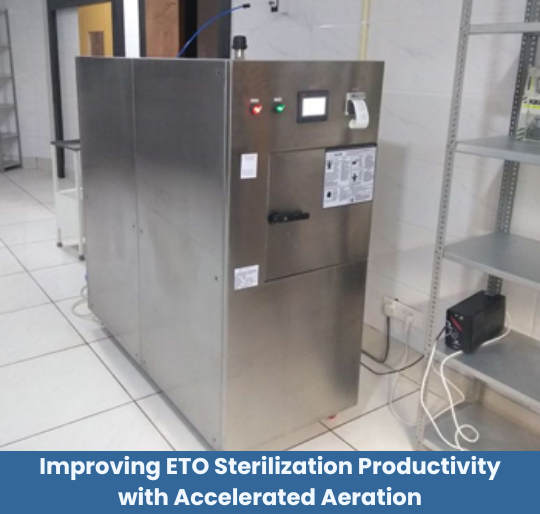
Modern Ethylene Oxide Sterilizer systems with in-built aeration capabilities or those designed for seamless integration with dedicated aeration units, make this transition operationally straightforward.
Our Other Product
Industrial ETO Sterilizer MachineETO Sterilizer Machine Design and Its Role in Cycle Performance
Not all sterilization equipment is engineered equally when it comes to cycle efficiency. The design specifications of an ETO Sterilizer machine directly influence how quickly and reliably cycles can be executed. Key design factors affecting cycle performance include:
- Chamber wall construction: Thicker stainless steel with superior insulation retains heat more consistently, reducing warm-up time and maintaining temperature uniformity throughout gas dwell.
- Vacuum and pressurization systems: Fast, precise vacuum draw-down and pressurization cycles reduce the non-productive portions of each cycle. ETO Sterilization machines with high-performance vacuum pumps and validated pressure control can shave significant time from cycle totals.
- Gas injection accuracy: Precise EO gas delivery systems avoid over- or under-injection, ensuring that the required concentration is reached quickly and held accurately throughout dwell.
- Automation and PLC control: Fully automatic EO sterilization equipment with PLC-based controls executes cycle phases without operator intervention delays, maintains precise parameter logs for regulatory compliance and reduces the risk of human error extending cycle time.
Facilities using hospital sterilizer equipment that combines these features can often reduce total cycle time by 20–30% versus older or less capable sterilization equipment, without any change to the validated cycle parameters.
ETO Sterilization Load Configuration and Packaging Impact
Load configuration within the ETO Sterilizer chamber significantly affects how quickly EO gas penetrates to all devices in the load. Poorly stacked or overpacked loads create gas shadow zones where concentration and humidity take longer to equilibrate, effectively extending the functional gas dwell time required.
Operations managers looking to reduce EO sterilization time through load optimization should work with validated load configurations that maintain adequate spacing between items and ensure uniform gas flow paths. Packaging design also plays a role; breathable packaging materials with appropriate porosity allow faster gas and moisture exchange, reducing both preconditioning and gas dwell requirements.
For Industrial ETO Sterilizer Machine users processing large batch volumes, validated load patterning studies conducted during cycle development can yield meaningful time savings across every production run.
Read Our Article
Role of ETO Sterilizers in Central Sterile Supply Departments (CSSD)Ethylene Oxide Sterilization Process Validation and Cycle Requalification
Many operations managers working within existing validated cycles are reluctant to investigate ETO cycle optimization for fear of triggering full revalidation. While validation requirements must always be respected, it is worth noting that half-cycle validation and process challenge device (PCD) methodologies allow the sterilization efficacy of reduced-time cycles to be demonstrated without necessarily running a complete revalidation from scratch.
Engaging the Ethylene Oxide Sterilizer manufacturer’s technical team during cycle review is advisable. They can provide data on equipment performance envelopes and previous validation datasets that support cycle time reduction proposals. For facilities where cycles have not been reviewed for several years, periodic requalification often reveals opportunities to streamline the cycle that have been locked in by historical conservatism rather than technical necessity.
Our Other Product
Table Top ETO SterilizerETO Sterilizer Equipment Monitoring and Preventive Maintenance
Unplanned downtime and cycle failures due to equipment faults are a leading but often underappreciated cause of poor sterilization productivity. A sterilization machine that fails mid-cycle due to a faulty gasket, degraded vacuum pump or inaccurate temperature sensor does not merely lose one cycle’s worth of time; it triggers investigation, remediation, reprocessing and often regulatory documentation requirements.
Implementing a structured preventive maintenance programme for all sterilization equipment, including routine gasket inspection, vacuum system testing and calibration of temperature and pressure sensors, is foundational to sustained sterilization productivity improvement. The most cycle-efficient sterilization operations are invariably those with the highest equipment reliability rates.
 WhatsApp Us
ETO Cycle Optimization: A Systematic Approach Delivers Sustained Gains
Reducing Ethylene Oxide sterilization cycle time without compromising sterility is achievable-but only when approached systematically. The variables at play across preconditioning, gas dwell, aeration, load configuration and equipment performance are interdependent; addressing any single element in isolation rarely delivers the full potential improvement. A structured ETO cycle optimization review, supported by validated data and capable sterilization equipment, consistently delivers sterilization productivity improvements that operations managers can measure in throughput, cost and compliance confidence.
Sterility Equipment: ETO Sterilizer and Sterilization Machines for Optimized Operations
Sterility Equipment India Private Limited, founded in 2014 and based in Ahmedabad, Gujarat, is an established manufacturer and exporter of Ethylene Oxide Gas Sterilizers, industrial ETO Sterilizer machines and sterilization equipment serving hospitals, medical device manufacturers, life science organizations, tissue banks and test laboratories across India and global markets.
The company’s product portfolio includes Table Top ETO Sterilizer models suited to clinical and surgical settings, Fully Automatic ETO Sterilizer units with PLC-based controls for reliable cycle execution and Industrial ETO Sterilizer Machines engineered for high-throughput sterilization of medical devices, PPE kits, herbal products and spices. All sterilization machines are built using quality-assured raw materials and incorporate modern engineering practices to deliver precise temperature, humidity and gas concentration control.