


Buyers of pharmaceutical, medical-device and laboratory equipment need a reliable way to identify construction errors, missing functions and documentation gaps before a sterilizer enters production. This is why sterilizer machine FAT and SAT are conducted as two separate acceptance checkpoints: FAT before dispatch and SAT after installation. Proper sterilizer machine acceptance testing confirms whether the supplied equipment matches the agreed technical, functional, safety and documentation requirements before unresolved deviations become more expensive to correct.
A factory acceptance test for a sterilizer examines the machine at the manufacturer’s facility, while the site acceptance test verifies installation-dependent functions under the buyer’s actual utility and operating conditions. For projects involving ethylene oxide equipment, ETO sterilizer testing may include vacuum operation, leak testing, cycle progression, alarms, interlocks, aeration and data-recording functions included in the approved specification. These checks also establish whether the equipment is ready to proceed into sterilization equipment commissioning and subsequent qualification activities.
Sterilizer Machine FAT and SAT: What Each Stage Covers
Factory Acceptance Testing is carried out at the manufacturer’s works before dispatch, while the machine is largely complete. It lets the buyer’s team inspect construction, run functional checks and observe control-system behaviour, while correction is still straightforward.
Site Acceptance Testing takes place after the sterilizer has reached the buyer’s facility, been positioned, connected to utilities and made ready for site-level checks. SAT verifies what only exists once installed, including utility and exhaust interfaces, communication with other site systems, and performance outside a factory test bay.
Participants typically include manufacturer and buyer representatives, quality assurance, engineering and validation staff. Scope, the tests to be witnessed, and sign-off authority should be agreed in writing before testing begins.
 WhatsApp Us
FAT vs SAT vs Commissioning vs Qualification
FAT and SAT are sometimes used loosely to mean commissioning or qualification. They are related but distinct.
| Activity | Usual Stage | Primary Purpose | Typical Basis |
| FAT | Before dispatch | Verify construction and agreed factory-level tests | Approved specifications and FAT protocol |
| SAT | After site installation | Verify installation-related functions and interfaces | SAT protocol and site conditions |
| Commissioning | During or after installation | Bring the equipment to an operationally ready condition | Manufacturer’s procedures |
| IQ/OQ/PQ | After prerequisites are met | Produce documented qualification evidence for intended use | Approved qualification protocols |
Records from FAT and SAT can help a qualification team later plan IQ, OQ and PQ, but a completed FAT or SAT does not by itself constitute qualification evidence.
Setting the Acceptance-Testing Basis
Acceptance testing works only when measured against something specific. Before FAT begins, the buyer’s team should have the approved User Requirement Specification, purchase order, technical offer, design specifications, layout drawings, component list and utility requirements, plus the FAT and SAT protocols, defined acceptance criteria, a responsibility matrix, and a deviation-handling procedure. Any missing, unclear or conflicting document should be resolved before testing starts, not debated on the factory floor.
Equipment Configuration and Specification Review
With the reference documents in place, the team compares the manufactured sterilizer against what was agreed: model and identification, chamber arrangement, door quantity and orientation, supplied accessories, control-panel arrangement, utility connection points, instrumentation, and how piping and components are identified. Access for operation and maintenance should also match the drawings. This review stops at configuration and identification, not construction materials or capacities never part of the agreed documentation.
Chamber and Door Inspection
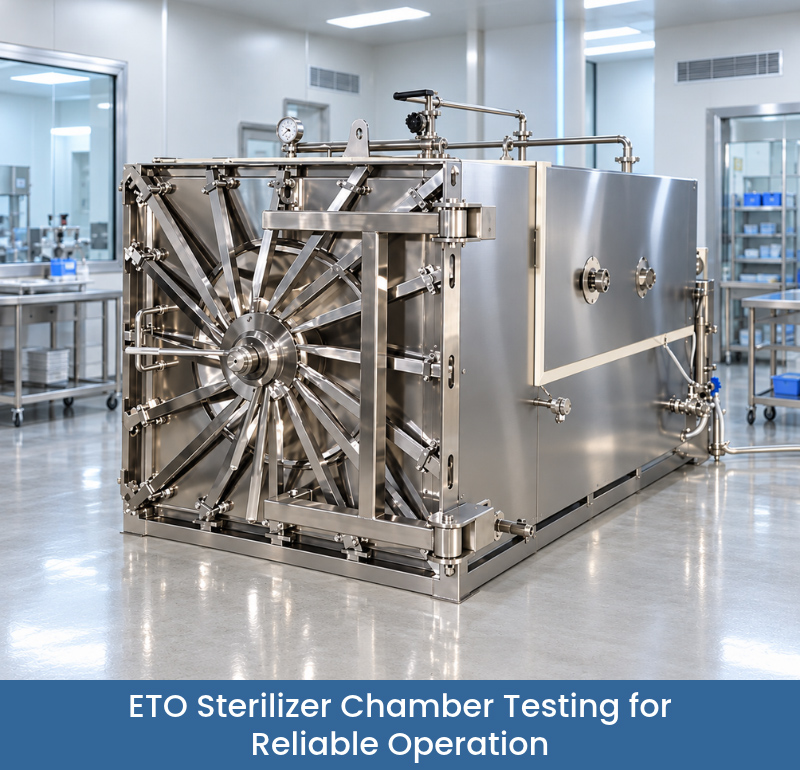
The chamber and door system are usually the most physically inspected part of a sterilizer machine, since they directly affect load handling and operator safety. Checks should cover general workmanship, visible chamber cleanliness and accessible internal surfaces, door movement, the closing and locking sequence, and door-position indication. Seal condition and alignment deserve close attention, as does interlock behaviour between doors where the design includes more than one. Manual or emergency door provisions, where specified, should be exercised and observed, using criteria from the approved design rather than general assumptions.
ETO Sterilizer Vacuum and Leak Testing
During a factory acceptance test for a sterilizer, vacuum and leak-related functions should be verified when they form part of the approved equipment design. The team should confirm instruments are within calibration validity, since a reading is only as trustworthy as the instrument producing it. The agreed test sequence, stabilisation period and recording method should be followed exactly as written in the protocol, and any out-of-limit result investigated before a repeat test. This article does not specify universal vacuum levels or leak rate limits. These must come from the approved specifications.
Alarm and Safety-Interlock Testing
Alarms and safety interlocks protect personnel and the load, so they are verified through controlled simulation rather than discovered during operation. Test areas may include door-status conditions, incorrect operating sequences, utility interruptions, out-of-limit process conditions, sensor faults, emergency-stop functions, cycle interruption, operator acknowledgement and the recovery sequence. Not every sterilizer carries the same alarms, so this should be read against the machine’s approved specification. Simulations must follow an approved procedure and never expose personnel or equipment to uncontrolled risk.
Control-Panel and Software Checks
The control system is reviewed against the approved functional requirements: displayed process information, user access levels, recipe or cycle selection, and restrictions on who can change parameters. Alarm history, date and time settings, data recording, and report generation should be checked, along with audit trail, password management or data backup functions where specified. Behaviour after a power interruption is worth observing directly, since a feature can look complete on paper but behave unpredictably in practice.
Cycle Simulation During FAT and SAT
A representative or simulated cycle lets the team observe how the equipment sequences through its stages and captures data, including predefined test conditions, cycle stage progression, sensor readings, timer operation, alarms generated, operator prompts, and the resulting cycle report. Interrupted cycle behaviour is also worth observing, since it shows how the control system handles an abnormal event mid cycle, reviewed against the protocol’s acceptance criteria. Witnessing a simulated cycle during FAT or SAT is a functional check, not a validation of the sterilization process for a specific product or load. That belongs to a separate qualification exercise.
Documents Required Before Dispatch
Before giving dispatch clearance, the buyer’s team should review the documentation package against what was contractually agreed: approved drawings, technical specifications, component and instrument lists with calibration certificates, the FAT protocol with completed test records, deviation reports and corrective-action evidence, operating instructions, utility details, a spare-parts list, agreement-specific certificates, dispatch documentation, and a record of pending or punch-list items. Not every document applies to every project.
Site Acceptance Testing After Installation
Once the sterilizer reaches the site, SAT verifies it under actual installation conditions rather than repeating factory tests unchanged. The initial review should cover transport damage, equipment identification, positioning, utility connections and exhaust interfaces where applicable.
Door operation, control-system start-up, alarms, interlocks and external-system communication should then be tested in their installed condition. The team should also observe cycle simulation and data recording, review outstanding FAT items and document site-generated deviations before handover. FAT results should not simply be copied into the SAT record, since site-dependent functions must be verified after installation.
Managing Deviations and Retesting
When a test fails or cannot be completed as planned, the observation should be described clearly, with expected and actual results tied to the specific requirement. The team should assess impact, assign responsibility for corrective action, define retesting requirements, and gather evidence before an item is closed. Conditional acceptance can let a project proceed while minor items remain open, but unresolved critical items should not be waved through to protect a schedule. A timeline saved by skipping a genuine deviation tends to cost more once the equipment is in service.
Final Sterilizer Inspection Checklist
A concise sterilizer inspection checklist can help confirm readiness before signing off either stage:
- Approved FAT and SAT protocols, specifications and drawings confirmed
- Test instruments identified and calibration status verified
- Sterilizer configuration, chamber and doors inspected
- Vacuum and leak tests completed where applicable
- Alarms and safety interlocks tested
- Control-panel functions, software access and data recording checked
- Representative cycle sequence witnessed and results recorded against acceptance criteria
- Deviations documented, corrective actions and retests completed
- Required documents received
- Dispatch or site punch-list items identified
- Commissioning responsibilities clarified
- Authorised acceptance signatures obtained
Common FAT and SAT Mistakes
A few recurring mistakes undermine acceptance testing: starting FAT without an approved protocol, working from vague acceptance criteria, or reviewing only visible construction without tracing tests back to the purchase requirements. Assuming a successful FAT removes the need for SAT, repeating FAT at site without checking site-specific interfaces, and treating a simulated cycle as process validation are equally common. Software and data checks are sometimes left until qualification, and instrument calibration is occasionally overlooked. Closing deviations on a verbal explanation without evidence, and leaving commissioning responsibilities undefined, resurface as disputes later. Issuing acceptance despite unresolved critical observations is the costliest version of this pattern.
 Email Us Now!
Sterility Equipment India Private Limited
Sterility Equipment India Private Limited, based in Ahmedabad, Gujarat, manufactures and exports ETO gas sterilizers. Its range includes table-top and fully automatic units as well as industrial sterilizer machines for different processing requirements, supporting hospitals, clinics, laboratories, tissue banks and medical-device processing applications. Buyers can discuss equipment specifications, testing requirements, documentation and FAT and SAT responsibilities with the company before finalising an order.
Conclusion: Getting Sterilizer Machine FAT and SAT Right
A meaningful sterilizer machine FAT and SAT process starts with approved, measurable requirements, and continues with physical, functional, safety and control-system checks recorded against those requirements rather than judged on impression. SAT must go further and confirm the equipment under its actual installation and utility conditions, since some behaviours cannot be observed elsewhere. Deviations and pending items need to be documented and closed with evidence, and the boundary between FAT/SAT and formal qualification should stay clear throughout. Agreeing responsibilities before testing begins saves both sides from disputes later. Buyers working through this process for any sterilizer machine are welcome to contact Sterility Equipment India Private Limited to discuss specifications, FAT and SAT requirements, and documentation for a smooth acceptance.