

Choosing between an in-house ETO sterilizer and contract sterilization services depends on product suitability, production volume, facility readiness, total cost and quality responsibilities. Steady demand alone does not settle the question; outsourced EO sterilization can also suit established manufacturers with predictable volumes. Neither model is universally superior, and the right choice depends on site specific evidence.
Product Suitability and ETO Sterilizer Feasibility
Before comparing an ETO sterilizer machine purchase with contract sterilization services, manufacturers need to confirm that ethylene oxide (EO/ETO) is actually the right process for their product. Device materials, construction and the intended packaging all influence whether a product can tolerate EO exposure without affecting its function or shelf life. Sterile barrier packaging must allow gas penetration during processing and aeration while still protecting sterility afterward.
Different product families often need different conditioning, exposure and aeration parameters, so grouping compatible products matters as much as the gas cycle itself. Residual ethylene oxide and ethylene chlorohydrin levels must stay within applicable limits, and this requirement does not change based on who owns the equipment.
Sterilization feasibility is a separate question from commercial feasibility. A device may be fully compatible with EO sterilization, yet an in-house ETO sterilization operation could still be the wrong choice if volumes, infrastructure or staffing cannot support it economically. Establishing product requirements first keeps the make or buy comparison grounded in what the product actually needs, rather than starting from equipment preferences.
 Email Us Now!
Production Volume and ETO Sterilizer Batch Utilisation
Production volume shapes nearly every later decision, but the raw annual unit count is not enough on its own. Manufacturers should look at whether demand is stable or fluctuating, what growth is realistically forecast, and how different product lines can be grouped into compatible loads for a single cycle.
Batch frequency and practical chamber utilisation matter more than theoretical capacity. A chamber that runs mostly part full delivers a very different cost picture than one that reaches planned utilisation consistently. Peak season demand and the spare capacity needed to absorb it should be assessed separately from average month figures, along with the minimum and maximum load configurations that have been validated for the product range.
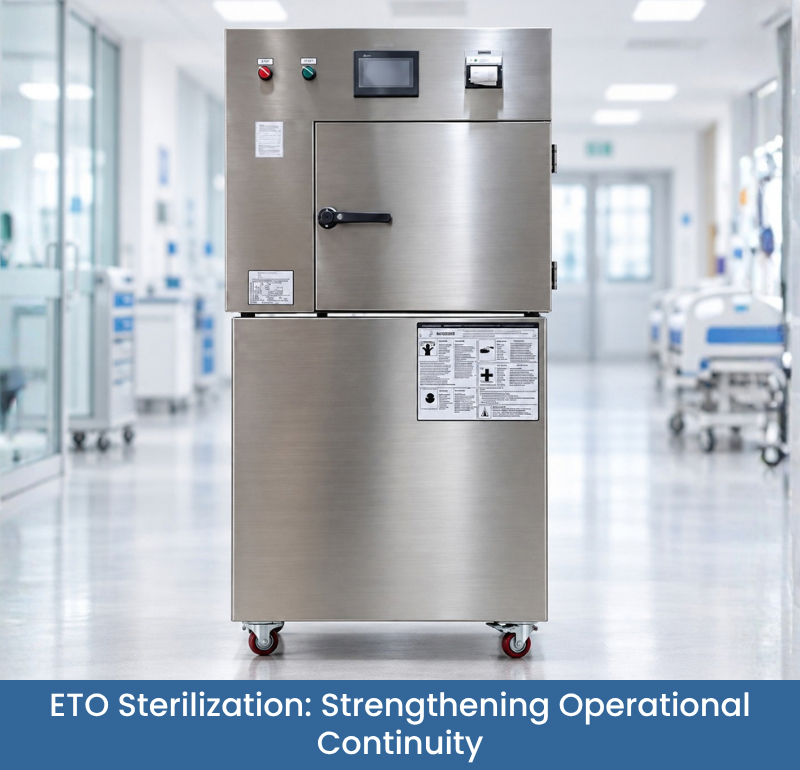
For manufacturers with lower or developing volumes, a Small ETO Sterilizer may be worth evaluating. The Table Top ETO Sterilizer range, available in 50-, 60- and 85-litre models, is sized for smaller or more variable loads without the footprint of a larger industrial unit, provided the loads fall within validated configurations for the product range. A smaller chamber size does not by itself make an in-house project financially sound.
ETO Sterilizer Process Lead Times and Transport Requirements
Turnaround time is often judged by quoted processing duration alone, but the more useful measure is the complete elapsed time from production completion to release of sterilized, saleable product.
For contract sterilization services, this includes preparing and packing the load for dispatch, transport to the provider’s facility, queueing for an available processing slot, the ETO sterilizer process itself, aeration, documentation review, return transport, and final release. These steps contribute to total turnaround time, and transport also introduces handling and packaging protection considerations that do not apply to an on site process.
For an in-house ETO sterilizer, the relevant steps are queueing for chamber availability, load preparation, the cycle, aeration, internal record review and release. Removing transport can shorten the end to end timeline, but internal queueing during busy periods can offset some of that advantage.
These lead time differences affect work in progress inventory levels and the delivery commitments a manufacturer can reliably make to customers. Manufacturers should map their own actual route rather than assuming either model is faster by default.
Infrastructure and Staffing for an ETO Sterilizer Machine
Owning an ETO sterilizer machine is only the equipment side of running a validated process. Physical readiness and people readiness need to be assessed separately, since a site can have one without the other.
Infrastructure considerations typically include:
- Installation space and material flow through the facility
- The utilities the equipment requires
- Gas handling and storage arrangements
- Ventilation and gas detection systems
- Exhaust treatment or abatement where applicable
- A defined aeration arrangement
- Ongoing maintenance access
- Local permissions or approvals needed to operate the site
Staffing considerations typically include:
- Trained operators for routine running of the ETO sterilizer process
- Engineering and maintenance capability to keep the equipment within specification
- Validation and microbiological expertise to support process qualification
- Quality assurance review and release arrangements
- Coverage across shifts and planned or unplanned absences
There is no universal headcount that applies across sites, and an automated chamber does not remove the need for specialist oversight; automation changes how staff interact with the process, not whether oversight is required.
ETO Sterilizer Cost Compared with Outsourced Processing Cost
A fair cost comparison has to cover equivalent scope over an appropriate planning period, not just the headline price of equipment against a per batch processing charge.
Internal costs may include:
- The equipment and its installation
- Facility modifications and supporting systems needed around it
- Process and product qualification work
- Labour, utilities and consumables
- Ongoing maintenance and calibration
- The cost of downtime or backup arrangements when the chamber is unavailable
External costs may include:
- Processing charges and any applicable minimum batch charges
- Transport and handling
- The carrying cost of inventory held during the external turnaround
- Validation transfer or product introduction work with the provider
- Additional testing or documentation charges
- Reserved capacity or expedited service charges where these apply
A practical way to compare the two is cost per released batch or saleable unit, calculated at realistic utilisation rather than theoretical maximum throughput. Any break even estimate should be built on verified quotations and site specific assumptions, and should be tested against changing demand, possible downtime and provider charge changes rather than relying on a single fixed threshold.
Validation and Quality Responsibilities in ETO Sterilization
Both models require validated sterilization, but how responsibilities are allocated differs.
Key areas to define include:
- Process development and validation in line with ISO 11135
- Product, packaging and load definition
- Routine process records
- Residual evaluation against ISO 10993-7
- Handling of deviations and nonconforming loads
- Assessment of changes that may trigger revalidation
- Access to and retention of records
- Release responsibilities
- The regulatory assessment the manufacturer must still carry out for its own device
For contract sterilization services, a written quality agreement is valuable for setting out who performs, reviews and approves each activity, so expectations are documented rather than assumed.
It is also important to distinguish the provider’s responsibility for running a validated process from the manufacturer’s own regulatory obligations for its product. A provider’s certification covers its processing capability and does not, by itself, validate a specific device or load configuration; that assessment remains the manufacturer’s responsibility in either model.
Provider Dependence and Business Continuity in EO Sterilization
Beyond cost and transport, manufacturers should look at how resilient each option is operationally.
For outsourced processing, this includes:
- The capacity a provider has available and whether any of it is reserved
- How priority is handled during periods of high demand
- Planned shutdowns and the risk of unexpected interruptions
- Access to a suitably qualified alternative provider if needed
- Practical constraints around switching providers
- Any change notification obligations in the service agreement
In-house operations carry their own continuity risk, since equipment downtime, an interrupted gas supply or the loss of trained staff can halt production just as a provider disruption would, so an internal operation needs its own defined backup plan rather than an assumption of constant availability.
ETO Sterilizer Make or Buy Decision Matrix
| Decision Factor | Evidence to Collect | May Favour In-House Processing When | May Favour Contract Processing When |
| Demand stability | Historical and forecast volumes | Demand is steady and predictable enough to plan utilisation | Demand is uncertain or still developing |
| Batch utilisation | Achievable loads per cycle, product groupings | Compatible products can reliably fill planned batches | Loads are small, infrequent or highly variable |
| Turnaround needs | Mapped end to end lead time | Delivery commitments need the shortest achievable internal cycle | Current provider turnaround already meets commitments |
| Site readiness | Space, utilities, permissions audit | Infrastructure requirements can be met without disproportionate investment | Facility changes would be extensive or disruptive |
| Specialist capability | Staffing and training assessment | Qualified staff are available or can be developed and retained | Specialist roles are difficult to recruit or retain |
| Cost | Verified quotations, realistic utilisation | Cost per released unit compares favourably at achievable utilisation | Outsourced cost per unit remains lower at current volumes |
| Quality responsibilities | Validation scope, record ownership, release authority | The manufacturer is equipped to own validation and release in full | A written quality agreement can clearly allocate responsibilities |
| Continuity | Provider terms, internal contingency options | A dependable backup plan exists for internal downtime | A qualified alternative provider is accessible if needed |
Manufacturers should first confirm which requirements are mandatory for feasibility, then compare the options that remain viable, and finally test any uncertain assumptions, such as utilisation forecasts or quoted charges, before approving capital investment.
 Call Us Now!
About Sterility Equipment India Private Limited
Sterility Equipment India Private Limited, founded in 2014 and based in Ahmedabad, Gujarat, manufactures Ethylene Oxide Gas Sterilizers for life science, medical device, tissue bank and test lab applications. Its range spans three categories.
The Table Top ETO Sterilizer is available in 50-, 60- and 85-litre models, suited to hospitals, research centres, laboratories and pharmaceutical applications. The Fully Automatic ETO Sterilizer is available from 100 to 450 litres and is used for medical devices and laboratory equipment.
The Industrial ETO Sterilizer Machine is available in chamber sizes from roughly 1.27 to 20.38 cubic metres, with single door or double door configurations, for the same range of applications. Manufacturers evaluating the purchase of an ETO sterilizer in India can review these capacities as one input into the infrastructure and staffing sections above.
Conclusion
No single factor settles the choice between an in-house ETO sterilizer and contract sterilization services; it rests on verified, site specific evidence across the factors weighed above. Manufacturers considering internal equipment are welcome to discuss their application and equipment requirements with Sterility Equipment India Private Limited.